System overview
How ArbiSim Guard is built — four layers from the user's agent down to the forked blockchain. Each layer has a clear responsibility and a hard boundary.
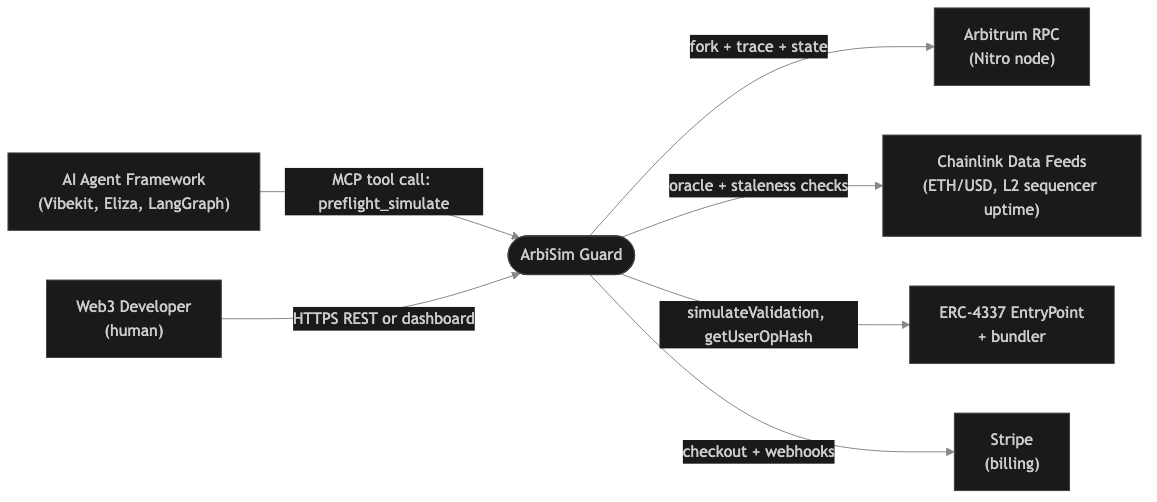
Client
HTTPS / MCP stdioWhere the user or their AI agent sends transaction plans to be checked.
Edge (Cloudflare Worker)
HTTP → QueueThe first line of defense. Validates the API key, checks rate limits, and forwards valid requests to the application layer. Runs globally with sub-10ms overhead.
Application (Node.js Gateway)
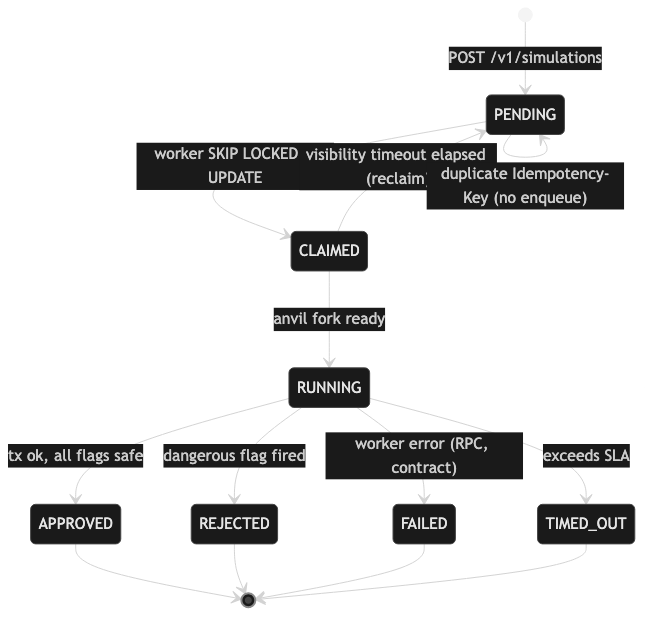
Postgres queueThe coordination layer. Accepts simulation requests, writes them to the queue, and returns results when the worker completes.
Data / Worker (Python)
JSON-RPC (Anvil)The actual simulation happens here. A persistent Anvil process forks the chain, executes the transaction, and the analytical engine parses the result into a structured safety report.
Key design decisions
Persistent Anvil processes
Instead of spawning a new fork for every simulation, ArbiSim keeps a live Anvil process per chain. Each simulation takes a snapshot, runs, then reverts to the snapshot. This reduces latency from ~4 seconds to under 100ms.
Cloudflare Workers at the edge
API key validation and rate limiting happen at the edge before any request reaches the origin. This means abuse and invalid requests never consume application resources.
Neon Postgres as the queue
Using SELECT FOR UPDATE SKIP LOCKED as a work queue removes the need for a separate message broker (Redis, SQS). Keeps the stack small and deployable on free tiers.
Separate Python worker
The simulation engine runs in Python (web3.py + subprocess Anvil). Python was chosen for its mature EVM tooling ecosystem. The Gateway (Node.js) communicates with it via the shared database.
External dependencies
Foundry AnvilLocal EVM fork engineNeon PostgresJob queue + API key storeMongoDB AtlasTelemetry (append-only)Cloudflare KVRate limit mirrorChainlinkAVAX/ETH price oraclesVercelFrontend hosting